Showing posts with label MCAFQ. Show all posts

Friday, February 16, 2018

Few and Proud in Third Fleet: Upcoming USMC Squadrons


An illustrated guide to new squadrons assigned to the United States Marine Corps detachment in Third Fleet. VMM-262 The Flying Tigers, equipped with MV-22 Ospreys, and HMH-466 Wolfpack operating the MH-90 MHF (NH Industries NH-90), both stationed at MCAF Quantico, the marines air facility that together with MCB Quantico will be inaugurated next March.

You will find the profiles of the aircraft flown by the two squadrons following the links below:
  
                                  MV-22 Osprey, VMM-262                          MH-90 MHF, HMH-466


It's a very exciting time in Third Fleet as we receive news that marines that served in SL before are turning to Quantico as a valid option to rejoin the Corps. We will welcome them into the fold and provide the support they require to once again represent proudly the real life naval institution that is the United States Marine Corps.

The same standards that govern Third Fleet apply to the 5th Marine Division, and we have a very capable officer in charge of this Third Fleet detachment, base and air facility. The options on the table are for the moment rotary wing, tiltrotor and heavy transport and cargo. Together with VMM-262 The Flying Tigers and HMH-466 Wolfpack, Quantico will mirror real life and become the home of HMX-1 The Nighthawks (Marine One) with MV-22's, and NAS Miramar will provide support for VMGR-152 Sumos, a KC-130/C-130T Hercules unit, and last but not least, Fat Albert Airlines, that is part of the Blue Angels demo squadron, flying a very special C-130T. More details on the remaining squadrons soon, along with a preview of MCBQ / MCAFQ. Stay tuned.

CAPT. Asra Kron
TFCOM

Wednesday, February 14, 2018

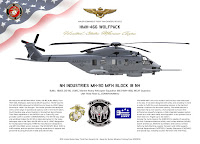
NH Industries MH-90 MFH Block 18 NH


NH Industries MH-90 MFH Block 18 NH, DD-80, BuNo 18003, from HMH-466, Wolfpack, stationed at MCAF Quantico. The 80 was the first MH-90 MFH delivered to MCAFQ and is flown by USMC Major Dominique “Alba” van Dongen. This model provides the Wolfpack with a wide range of operational options in the North Satori, South Nautilus area where Quantico is located but also enhances Third Fleet capabilities in the PATROU role in Tuarua Fiji, and provides CSAR in southern COMNAVAIRNAU.
The MH-90 size, range and workload makes the NH 90 an ideal alternative for the heavy helicopter role in the Fleet. MH-90 MFH is the SL USMC designation for multipurpose helicopter, NH90 the manufacturer designation, and MFH the USMC version indicator. The MH-90 MFH Block 18 NH is AAR enabled, and can perform hovering extractions of material and personnel by using the built in belly and side winches.

Real Life Notes:

The NH90 NFH is the most modern and the best naval helicopter in its class. It has been designed with safety and versatility in mind in order to fulfill the most demanding missions in the harshest
weather conditions for the XXIst century. The NH90 features a redundant fly by wire system, a full composite corrosion free airframe, two powerful engines, a fully integrated weapon system
as well as a wide cabin easily reconfigurable. It can operate from a
shore base or a Frigate up to sea state 5.
Among the multi-missions the NH90 NFH is capable of executing are Anti Submarine Warfare (ASW), Anti Surface Warfare (ASuW), Search and Rescue, Maritime Surveillance and Control, Limited Airborne Early Warning, Logistic Transport and Utility support, Vertical Replenishment (VERTREP), Casualty Evacuation (CASEVAC), and Special Ops, including Counter Terrorism and Anti-Piracy.

CAPT. Asra "Cougar" Kron
NASMCO / TFCOM

Saturday, February 10, 2018

Bell Boeing MV-22 Osprey


The Bell Boeing MV-22 Osprey, the USMC version of the V-22 in use by the United States Navy, is in use by three squadrons in the USN Third Fleet SL. The portrayed aircraft, BuNo. 18005, DD-30, belongs to VMM-262 “The Flying Tigers”, and is flown by Major Dominique “Alba” van Dongen, the commanding officer of Marine Corps Air Facility Quantico, located in the North coast of the Satori continent, where the Tigers are stationed.
The DD-30 has a medium visibility commander color scheme, the other aircraft in the squadron using the low visibility marine gray livery, and is the first of a projected three aircraft delivery to be fulfilled until April 2018, together with the two MV-22 Ospreys to be deployed with HMX-1 that, as in real life, is stationed at MCAF Quantico, handling the transport of very important persons in Second Life, whereas the real life HMX-1 is the presidential squadron.

Used in a variety of roles, from CSAR to COD and long range patrols, the VMM-262 Ospreys operate mainly in the southern COMNAVAIRNAU area, covering not only the Satori continent but also Nautilus South and the Blake and Islands regions, with support capability in the Nordic easternmost area of the Blake.
The MV-22 has air-to-air refueling capability which enables it a virtually limitless range, provided tankers can support its operations. It can carry a variety of cargo or external loads and inside up to 20 heavily equipped marines or marine parachutists, or 10 assault equipped marines and a light attack vehicle.

Real Life Notes:

The V-22 Osprey is a joint service multirole combat aircraft utilizing tiltrotor technology to combine the vertical performance of a helicopter with the speed and range of a fixed-wing aircraft. With its rotors in vertical position, it can take off, land and hover like a helicopter. Once airborne, it can convert to a turboprop airplane capable of high-speed, high-altitude flight. This combination results in global reach capabilities that allow the V-22 to fill an operational niche unlike any other aircraft.

The V-22 Osprey meets U.S. Navy and U.S.M.C. requirements for CSAR (combat search and rescue), COD (fleet logistics support), and special warfare support, matches the U.S. Special Operations Command’s requirement for a high-speed, long-range, vertical lift aircraft, can be stored aboard an aircraft carrier or assault ship because the rotors can fold and the wings rotate, has air-to-air refueling capability, the cornerstone of the ability to self-deploy and can carry 24 fully equipped troops or 20,000 pounds of internal cargo, or in alternative 15,000 pounds of equipment externally.
The Osprey program faced several developmental challenges since its first flight in 1989, including several crashes during tests that resulted in 30 deaths. But the Navy and Marine Corps developed new flight techniques and enhanced systems before it first deployed to Iraq in support of Marine operations in Anbar province and the aircraft has proven safer than many rotary-wing aircraft in the fleet.

CAPT. Asra "Cougar" Kron
NASMCO / TFCOM